
Sorry for the inconvenience.
Search again what you are looking for

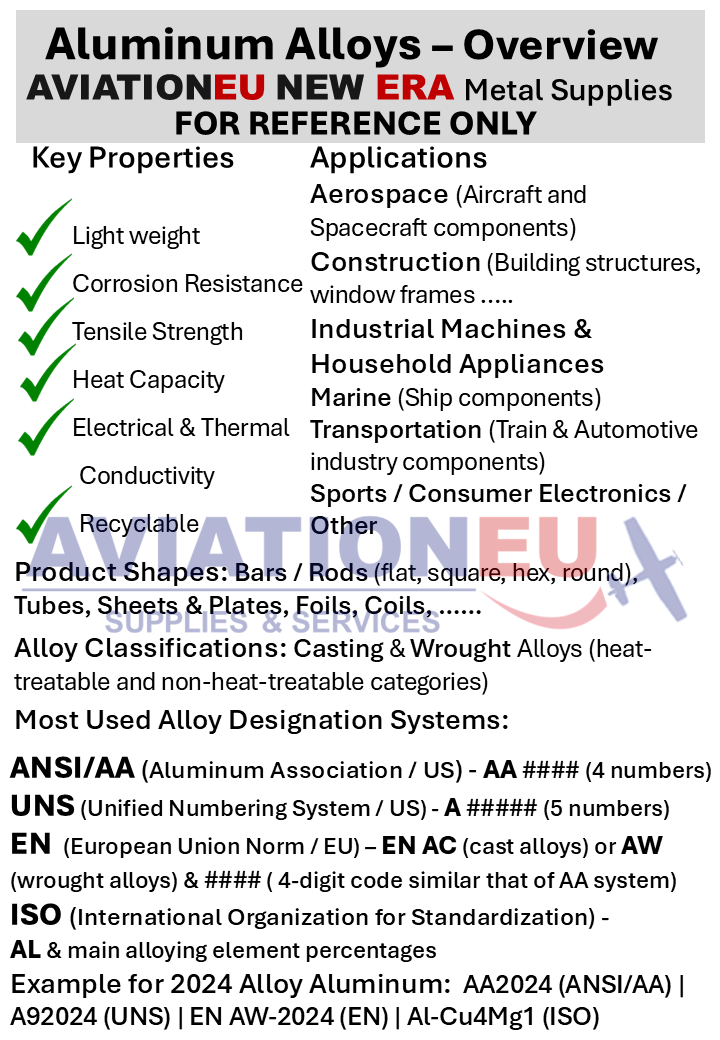
One of the most popular metals in manufacturing today is Aluminum used to produce products in almost limitless combinations of alloys, grades, tempers, finishes, shapes and other characteristics for an almost limitless number of different uses, from our everyday utensils to aerospace and military applications.
Aluminium and its alloys are essential materials in various industries such as aerospace, marine, construction, and automobile. As pure aluminium is relatively soft, small amounts of alloying elements are added to produce a range of mechanical properties. Each alloy has attributes such as high strength, conductivity, and even resistance to environmental effects.
There are two major alloy classifications: casting and wrought alloys. These can be further subdivided into heat-treatable and non-heat-treatable categories, depending on the means by which the alloying elements develop mechanical properties.
Naming (designator) systems have been developed by the US ANSI / Aluminum Association, ISO & other Standards organizations, to organize them on the basis of their composition.The designation system of aluminum alloys developed by the US ANSI / Aluminum Association begins with AA followed by four numbers: AA #### with the first number indicating aluminum’s main alloying element. This system enables grouping of aluminum alloys into families based on the primary alloyed metal.
In the case of wrought alloys different alouminum alloy series include:
1000 Series - at least 99.00% or higher aluminum purity. Low mechanical properties, excellent corrosion resistance, excellent workability, high thermal and electrical conductivities. Commonly used in the electrical and chemical industries.
2000 Series - group of "hard alloys" with copper as the primary alloying element. These alloys are known for high performance and excellent strength over a broad range of temperatures but can be the most challenging to weld. They find use in many industries, including the aerospace sector. Products of these alloys can be supplied in different grades (e.g. 2014, 2024), with or without heat treatment (O) (Annealed condition). Depending on the selected product and grade, they are intended for use in different industries, from packaging production, and mold making to aerospace, automotive, motorsports, shipbuilding, defense equipment, and other applications. Those from 2007 grade aluminum, made from a blend of high copper content, magnesium, and lead, are used mostly for machine parts, bolts and nuts, and threaded components.Those from 2014 grade (the second most popular alloy in its series, just after 2024) are known for their strength, toughness and machinability. Used in the manufacturing of machine and aerospace parts, and in buildings. The 2017 grade are easy to bend, simple to shape, they can resist corrosion, and feature good ductility and machinability. Used for aircraft and construction parts. Their 2019 grade counterparts feature a high copper content, making them less resistant to corrosion compared to 5000 and 7000 series alloys while exhibiting high strength and good heat resistance. Used in applications in the aerospace industry and in buildings. Products from 2024 grade aluminium alloy (also known as Aerospace Aluminum), with copper as the primary alloying element, are used in applications requiring high strength to weight ratio, good fatigue resistance, weldablility and average machinability. Typical applications include structural and other components for the Aerospace, Defence, Automotive, Sports, Marine & other industries such as wing skins, body panels, wheel axles, bicycle frames, hulls & masts, railing, & fasteners.
3000 Series - general-purpose alloys with manganese as the primary alloying element. Used in moderate-strength applications requiring good workability.
4000 Series - primarily alloyed with Silicon, these alloys feature a lower melting point which improves fluidity when molten. Often used in welding rods and brazing sheets.
5000 Series - aluminium alloys with magnesium as the primary alloying element. These alloys are readily weldable and feature a high tensile strength and formability, and a good resistance to corrosion in marine atmospheres, making them suitable for use in boat hulls, gangplanks, tanks, and bridges.
6000 Series - aluminum alloy family with magnesium and silicon as their major alloying elements. The remarkable properties of 6000 alloys are their extrudability, excellent strength, and high corrosion resistance.
7000 Series - aluminum alloys with zinc as main alloy element. They are the hardest and strongest commercial grades of aluminium, a preferred choice for applications of aerospace, vehicle and high-demanding industries.
In addition to their composition, alphanumeric temper designations are used after the alloy designation specifying how the alloy has been mechanically and/or thermally treated to achieve its strength and other desired properties. Aluminium alloy temper designations, denoted by capital letters (F, as fabricated | O, annealed | H, strain-hardened | W, solution heat-treated |T, thermally treated) relate to the general class of treatment.
Aluminum alloy metals from different series are offered as part of our own labelled (AVIATIONEU NEW ERA) product lines in various forms (tubes/pipes, sheets/plates, bars/rods). Sourced from quality producers, they are offered in different cross-sections (for tubes or bars) such as round, hexagonal, square and others, tempers, specifications (depending on the selected product) dimensions/thicknesses, pre-cut or cut-to-order lengths to meet order quantity and application requirements. They can be supplied in pieces or tons depending on the wanted order quantity. For additional information, please refer to the respective sub-categories and product presentations or contact us.
Basic information in text and image forms, and attachments are included as part of the respective product presentations. For additional information please consult the available resources at our AviationEU Resource Repository.
Media files (such as articles, product reviews, brief quides, comparison tables/charts, reference documents for different standards/specifications, product catalogs/brochures, and other documntation) are now included in our repository. Listed in menus, and categorized with the use of taxonomy terms for fast search and easy association with different user groups, these resources can be used for both teaching/learning and informational purposes by different groups (e.g. procurement specialists & project co-ordinators in aviation & industrial companies, teaching & research personnel in academic/research institutes, tenderers and many others). Access to these resources is free of charge to all our active customers(*) and on a paid subscription basis to all others. Subscription charges can be customized depending on the number of users and single or multiple tier subscription content access based on the selected taxonomy term(s), e.g. metals, fasteners, lubricants, etc.
For any further information or clarification on our listings please contact us.
(*) Active customers are those who have placed and paid for at least one order during the last 12 months from current date.
The information supplied in individual product presentations is based on published data from the manufacturers/ distributors and/or other sources and it is believed to be accurate. However, such information is furnished upon the express condition that the prospective buyers shall make their own assessment to determine the product suitability for their particular application/purpose. AVIATIONEU GROUP companies cannot be held responsible for the validity and accuracy of the appearing information and product specifications. In the case of chemicals, please also refer to their technical data sheets, labels and material safety data sheets (as applicable) before using them.
Search again what you are looking for