
Sorry for the inconvenience.
Search again what you are looking for

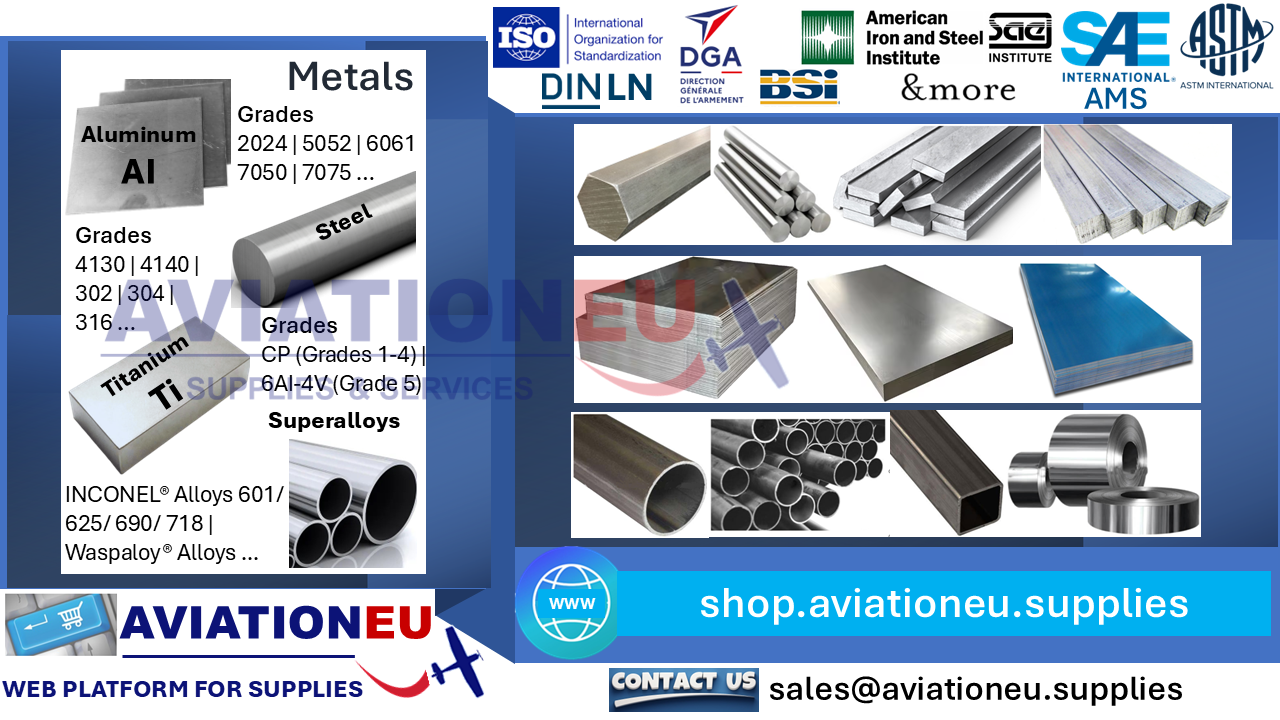
This category includes a range of metals such as steel, aluminum and others, in different alloys and tempers, used for manufacturing products in different forms (sheets and plates, bars/rods, tubes, wires, etc.). They are widely encountered in aerospace, automotive and many other industrial sectors. Alloys are created by adding small amounts of metallic elements into the base metals to improve their characteristics. These “alloying” elements allow a base metal to improve its attributes and better respond to the requirements of specific applications. Alloy metals an be classified in a variety of different ways depending on their composition (e.g. carbon, low-alloy or stainless steel, in the case of steels), manufacturing methods, finishing method (such as hot rolling or cold rolling), product form (bar,sheet, tube, etc), heat treatment (such as annealing, quenching and tempering), required strength level as specified in ASTM standards) and others. Because of the wide variety of chemical compositions possible and the fact that some steels are used in more than one heat-treated, condition, some overlap exists among the alloy steel classifications.
In the case of aluminum alloys, each alloy has attributes such as high strength, conductivity, and even resistance to environmental effects. A naming system using four-digit designators has been developed by the US Aluminum Association, to organize them. The first digit represents the specific alloying elements and general characteristics of the group, or the “series”.
In selecting an alloy, its mechanical properties should be carefully considered. The mechanical properties of different alloys differ based on how they are heat treated, or made stronger using the tempering process.
Some important measures when considering mechanical properties include the yield strength, ultimate strength, shear strength, fatigue strength, as well as the modulus of elasticity and shear modulus. The yield strength describes the maximum amount of stress needed to elastically deform the part in a given loading arrangement (tension, compression, twisting, etc.). The ultimate strength, on the other hand, describes the maximum amount of stress a material can withstand before fracturing. Before the fracture point, the material will undergo plastic (or permanent) deformation, and will not return to its original shape. For static applications, the yield strength is the more important design constraint as per industry standard design practices; however, the ultimate strength can be useful for certain applications where this kind of deformation is possible. The shear strength measures the maximum amount of “shearing” stress that a material can experience before it permanently deforms. Fatigue strength is the ability of a material to resist breaking under cyclical loading, where a small load is repeatedly imparted on the material over time. This value is useful for applications where a part is subject to repetitive loading cycles such as vehicle axles or pistons. The modulus of elasticity and shear modulus are measures of a material’s resistance to deformation.
Sourced from quality producrs, a wide range of metals are offered, most of them as part of our own branded (AVIATIONEU NEW ERA) product lines. They are available in pre-cut dimensions or cut-to-oder, meeting different specifications and in diferent units of sale, (pieces or tons) depending on the wanted order quantity and requirements. Please refer to the respective sub-categories and the individual product presentations for additional information.
Basic information in text and image forms, and attachments are included as part of the respective product presentations. For additional information please consult the available resources at AviationEU Resource Repository.
Media files (such as articles, product reviews, brief quides, comparison tables/charts, reference documents for different standards/specifications, product catalogs/brochures, and other documntation) are now included in our repository. Listed in menus, and categorized with the use of taxonomy terms for fast search and easy association with different user groups, these resources can be used for both teaching/learning and informational purposes by different groups (e.g. procurement specialists & project co-ordinators in aviation & industrial companies, teaching & research personnel in academic/research institutes, tenderers and many others). Access to these resources is free of charge to all our active customers(*) and on a paid subscription basis to all others. Subscription charges can be customized depending on the number of users and single or multiple tier subscription content access based on the selected taxonomy term(s), e.g. metals, fasteners, lubricants, etc.
For any further information or clarification on our listings please contact us.
(*) Active customers are those who have placed and paid for at least one order during the last 12 months from current date.
The information supplied in individual product presentations is based on published data from the manufacturers/ distributors and/or other sources and it is believed to be accurate. However, such information is furnished upon the express condition that the prospective buyers shall make their own assessment to determine the product suitability for their particular application/purpose. AVIATIONEU GROUP companies cannot be held responsible for the validity and accuracy of the appearing information and product specifications. In the case of chemicals, please also refer to their technical data sheets, labels and material safety data sheets (as applicable) before using them.
Search again what you are looking for